

The global self service kiosk market is now a formidable multi-billion-dollar industry—valued at approximately $26.4 billion in 2024, with projections exceeding $41.7 billion by 2029. This rapid growth, at a compound annual growth rate (CAGR) of over 7%, underscores both its maturity and high potential. In today’s competitive arena, the battle is no longer only about hardware; it revolves around innovation speed, supply chain control, customization capabilities, and complete solution delivery.
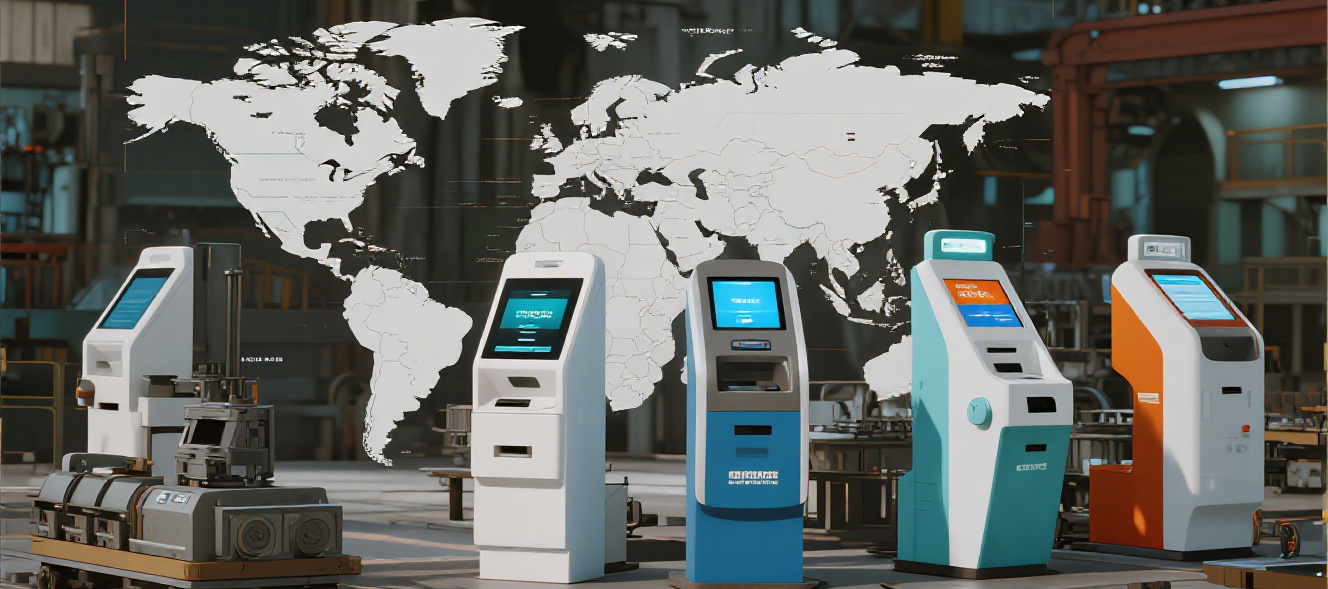
Regional Market Differences Shape the Competitive Landscape
Global demand for self service kiosks varies significantly by region, reflecting differences in infrastructure, regulatory environments, and consumer behavior.
North America & Europe: The market emphasizes software-driven integration with advanced security features such as PCI-compliant payment systems, biometric authentication, and GDPR-compliant data handling. Regulatory certification processes are stringent, requiring extensive testing and documentation before deployment.
Middle East & Africa: The focus is on rugged, weather-resistant outdoor kiosks designed to operate in extreme heat and sand-prone environments. Power stability solutions and high-brightness displays are critical.
Asia-Pacific (APAC): Southeast Asia shows strong demand for cost-effective, modular kiosk systems that can be deployed quickly in expanding retail and public transport networks. In more developed APAC markets such as Japan and South Korea, high adoption of cashless payment kiosks is driven by digital economy penetration.
Latin America: Growth potential lies in banking, ticketing, and government service kiosks, but security against vandalism and anti-theft measures are key procurement factors.
Understanding these regional nuances allows manufacturers to adapt their design, component sourcing, and local compliance strategies to each market.
Key Factors Driving Industry Competitiveness
The competitive edge in the self-service kiosk industry is determined by several interconnected factors:
Modular & Scalable Design: A modular architecture enables manufacturers to produce a base model that can be upgraded with specific functional modules—such as NFC payment, barcode scanning, facial recognition, or ticket printing—without redesigning the entire unit. This reduces R&D cost and shortens customization cycles.
Supply Chain Integration: Manufacturers with vertically integrated supply chains—covering sheet metal fabrication, PCB assembly, and final system integration—can better control costs, quality, and lead times. This advantage becomes critical in large-scale rollouts or urgent replacement projects.
Automation & Quality Consistency: Robotic welding, CNC bending, and automated painting systems ensure tight tolerances and repeatable quality, essential for multi-unit deployments in sensitive environments such as airports or government facilities.
Cost Management & Production Scalability: The ability to switch between low-volume, high-customization batches and high-volume standardized production allows manufacturers to serve both niche markets and mass deployments.
After-Sales Support & Localization: Beyond manufacturing, strong regional technical support and localized spare parts supply can influence purchasing decisions as much as initial pricing.
The Strategic Advantages of Chinese Manufacturing
Chinese manufacturers leverage end-to-end production capabilities—from sheet metal processing to complete kiosk assembly—within a single facility. This reduces dependency on third-party suppliers, minimizes transportation costs, and enables faster prototype-to-production timelines. Investments in smart factories with robotic welding, automated bending, and flexible production lines allow rapid adaptation to different kiosk configurations. Coupled with a high degree of design customization and the ability to meet international certification standards, Chinese manufacturing delivers competitive value to B2B clients worldwide.
Global Expansion Strategies for Chinese Manufacturers
Many Chinese kiosk manufacturers are shifting from price-based competition to solution-based positioning. By offering OEM, ODM, and joint development partnerships, they allow overseas clients to reduce engineering investment and accelerate deployment schedules. Building trust through export case studies, industry certifications (CE, UL, RoHS), and proven large-scale projects helps Chinese brands penetrate regulated markets where procurement decisions are highly risk-averse.
Future Challenges and Opportunities
The next decade will bring both challenges and opportunities. Trade policies, shifting compliance requirements, and rapid AI integration in kiosk interfaces will reshape competition. Sustainability will also play a larger role, with manufacturers needing to adopt eco-friendly materials, low-energy components, and recyclable enclosures. For Chinese manufacturers, the strategic priority is to maintain cost leadership while continuously improving innovation, quality, and sustainability—ensuring they remain a dominant force in the global self service kiosk market.