

From metro stations to shopping malls, from airports to government offices — self service kiosks have become an integral part of our everyday lives. But where did it all begin? How did these machines evolve from simple dispensers into intelligent, interactive kiosks?
In this article, we take a deep dive into the global history of self service kiosks, tracing their journey from early mechanical devices to today’s AI-powered smart systems — and offering a glimpse into what the future holds.
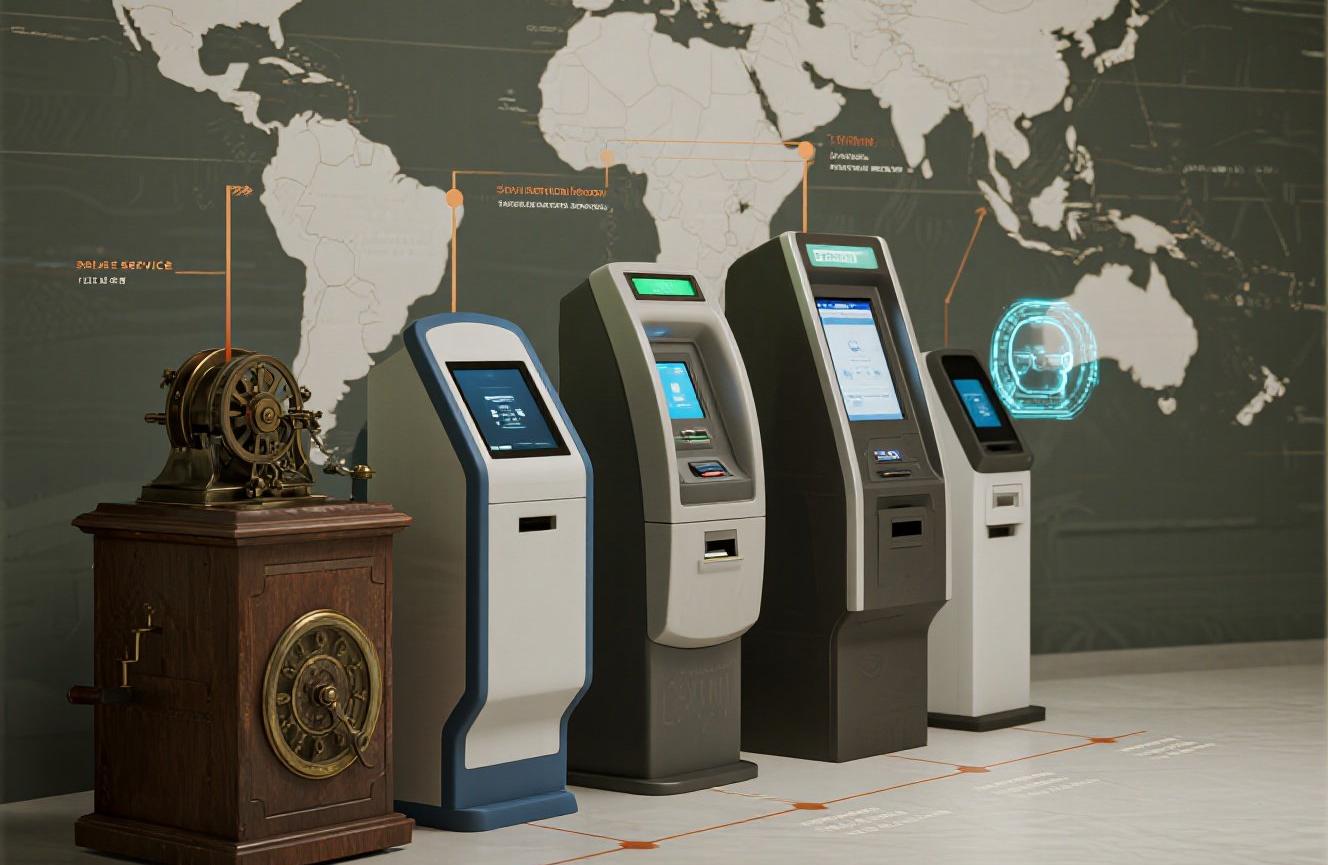
The Origin: Mechanical Beginnings in the 19th Century
The idea of automated self service dates back over a century. The earliest known self service machine was a coin-operated vending machine, introduced in London in the 1880s, dispensing postcards and newspapers.
Soon after, Japan and the United States followed suit with machines selling chewing gum, drinks, and snacks — marking the beginning of the global self service culture.
1960s–1980s: Rise of financial and self ticket kiosk
The first major breakthrough came with the development of the Automated Teller Machine (ATM Kiosk) in the 1960s, revolutionizing banking by allowing 24/7 access to cash.
Meanwhile, self service ticketing kiosks began appearing in transportation hubs in Japan, Europe, and the U.S., offering passengers more control over their travel planning.
Touchscreen technology was still in its infancy, but the foundation for interactive kiosks had been laid.
1990s–2000s: The Internet Era and Touchscreen Innovation
As touchscreen displays became more affordable and Internet connectivity more widespread, kiosks entered a new era. Businesses began adopting interactive kiosks for:
-
Hotel check-ins
-
Bill payment
-
Retail product lookup
-
Public information centers
Countries like South Korea, Singapore, and Germany led public sector adoption, while the U.S. and China drove commercial deployment.
2010s–Now: Smart, Connected, and Customizable
The last decade has seen exponential growth in kiosk innovation:
-
IoT-enabled kiosks now support real-time monitoring and remote management
-
AI and facial recognition technologies allow for personalized services
-
Modular design and customization meet specific industry needs
Today’s self service kiosks are found in healthcare, education, logistics, smart cities, and more — offering much more than transactions: they deliver data, experiences, and automation.
Manufacturers like Meiding Industrial have helped drive this evolution by offering end-to-end solutions — from sheet metal fabrication to system integration — ensuring both quality and scalability for global clients.
The Future: Hyper-Personalized, Sustainable, and Contactless
Looking ahead, several key trends are shaping the next generation of self service kiosks:
-
AI-driven personalization: Custom recommendations and multilingual interfaces
-
Biometric authentication: Fingerprint, palm vein, and facial recognition
-
Green design: Low-power consumption and recyclable materials
-
Edge computing: Faster response without relying on cloud latency
-
Fully contactless experiences: Especially in healthcare and hospitality sectors
The future of self service kiosk is not just more automation — it's smarter, safer, and more human-centric.
Conclusion
From mechanical vending machines in Victorian London to AI-powered kiosks in today’s smart cities, self service kiosks have come a long way. As technology continues to evolve, so will the role of kiosks — becoming more adaptive, more intelligent, and more essential in our connected world.
At Meiding Industrial, we are proud to contribute to this global evolution through our commitment to quality manufacturing and efficient integration — helping businesses bring their kiosk ideas to life.
Frequently Asked Questions
1. What are the key milestones in the history of self service kiosks?
Major milestones include the first vending machines in the 1880s, the rise of ATMs in the 1960s, the widespread use of touchscreen kiosks in the 1990s, and the integration of IoT and AI technologies in the 2010s.
2. What industries use self service kiosks today?
Self service kiosks are widely used in hospitality, retail, healthcare, banking, transportation, logistics, education, and government services — with applications ranging from check-in kiosks to digital signage and smart lockers.