

But how did we get here? What does the future hold for these self service kiosks? And where do hardware manufacturing specialists fit into this digital public infrastructure?
A Brief History: The Rise of Government Service Kiosks
Phase I: Basic Automation (1990s–2005)
Early use of kiosks in government was limited to basic functions—tax document printing, appointment ticketing, or DMV-related tasks in the U.S. These systems lacked biometrics, were often offline, and relied on simple card-swiping and dot-matrix printing.
Phase II: Integrated Identity (2005–2015)
The emergence of national e-ID programs (like Estonia’s X-Road or India’s Aadhaar) enabled kiosks to authenticate citizens securely. Governments started bundling multiple services—such as birth certificate issuance, social security verification, and fine payments—into a single terminal.
Phase III: Smart Government Terminals (2015–2020)
Biometric verification (facial recognition, fingerprint), touchscreen UIs, multilingual interfaces, and remote cloud-based management became standard. Cities like Dubai and Singapore deployed thousands of kiosks at airports, malls, and police stations.
Phase IV: Contactless and AI-Driven (2020–Present)
COVID-19 accelerated demand for contactless services. Voice driven kiosks, emotion aware interfaces, and app-integrated QR sign ins emerged. Public Service Kiosks are no longer static points but dynamic parts of omnichannel government platforms.
Diverse Approaches Across Countries
United Arab Emirates
Over 90% of government services are now accessible via smart kiosks (source: Smart Dubai Initiative), covering visa renewals, ID updates, and traffic fines. Terminals are found in malls, airports, and metro stations, offering 24/7 multilingual access.
Estonia
Although most services are online, the government deploys kiosks in rural libraries and post offices to bridge digital access gaps. Integrated with e-ID and healthcare databases, they serve as trusted digital gateways for citizens without smartphones or stable internet.
United States
State level departments such as the DMV offer license renewal and registration kiosks in retail chains like AAA and Safeway. ADA compliance, modular design, and integration with backend databases are standard requirements.
China
China has become one of the largest deployers of Government Service Kiosk, particularly since the launch of the “Run Once at Most” initiative in 2016. Provinces like Zhejiang and Guangdong have rolled out tens of thousands of smart terminals in city halls, hospitals, police stations, and even neighborhood convenience stores. These kiosks support complex workflows: ID verification, facial recognition, tax record printing, health insurance inquiries, and multi-channel payments—all in one unit. According to iResearch, by 2023, over 60% of urban citizen facing government services could be accessed via unattended terminals. China also serves as the manufacturing hub for global self-service kiosk supply chains, with many OEM/ODM providers supporting overseas deployments in Asia, Africa, and the Middle East.
Indonesia and Kenya
Emerging markets are rapidly deploying Utility Payment Kiosk and basic public service kiosk—often in partnership with telcos and mobile money providers—to expand access to digital services in rural and underserved areas.
What’s Next: The Future of Government Self Service Kiosks
According to Allied Market Research, the global self service kiosk market will surpass $42 billion by 2028, with government applications among the fastest-growing segments. Future trends include:
-
AI-Powered Dialogue: Kiosks will evolve into conversational interfaces using large language models.
-
Interoperability with Mobile Apps: QR code check-ins, hybrid document submission, and cloud-sync capabilities.
-
Biometric Fusion: Combined facial, iris, and voice authentication to prevent identity fraud.
-
Green and Paperless Terminals: With growing ESG standards, governments are moving toward energy-efficient, fully digital kiosks.
The Hardware Backbone: Why Manufacturers Matter
Behind every Government Service Kiosk is a complex set of integrated modules: ID readers, passport scanners, receipt printers, NFC enabled payment modules, and biometric cameras. Hardware must be:
-
Durable under 24/7 operation
-
Secure against tampering and data leakage
-
Modular enough to support different form factors and service bundles
-
Certified (CE, FCC, RoHS, ADA, GDPR-compliant)
OEM/ODM hardware manufacturers—particularly those with vertical integration—are mission-critical but often overlooked players in the public digitalization supply chain.
Case-in-Point: Meiding Industrial’s Role as a Silent Enabler
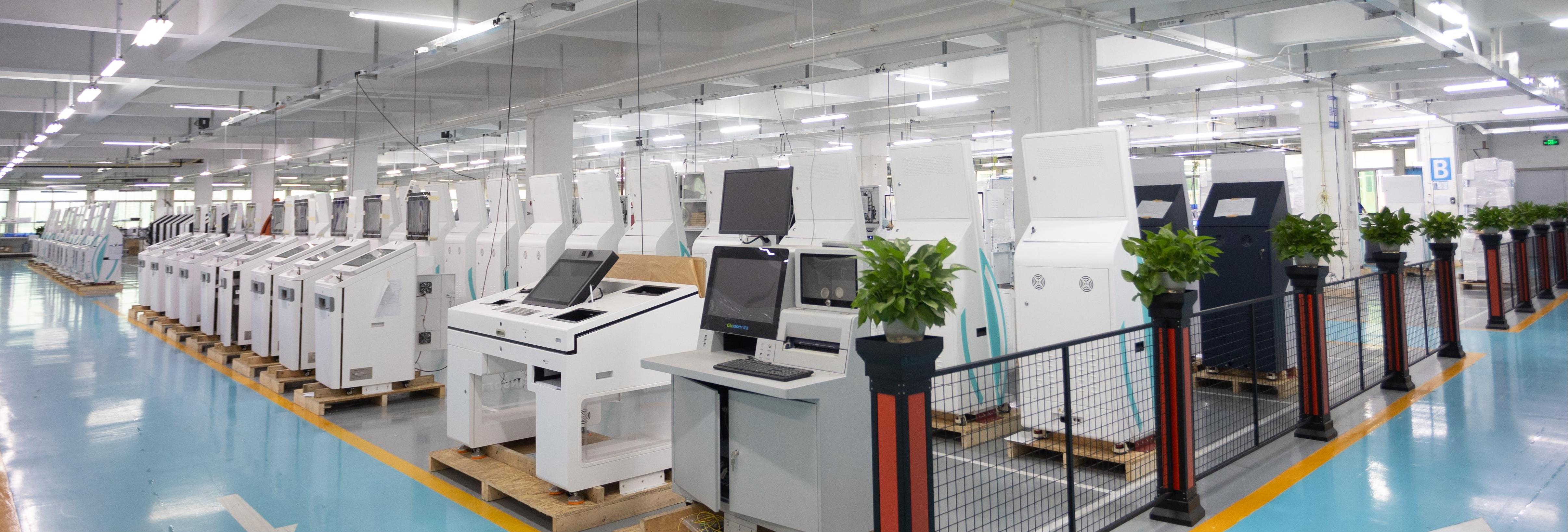
One such manufacturing partner is Meiding Industrial, a China based hardware integrator with over 12 years of experience and a 50,000㎡ semi-automated production facility. Rather than competing for public contracts directly, Meiding works behind the scenes with system integrators and software firms in delivering kiosk hardware tailored for government use. Their services include full system OEM/ODM kiosk manufacturing, pre-assembly of components, sheet metal enclosure production, modular design, and compliance with international hardware certifications.
This model supports efficient scaling for government-focused tech firms that lack internal hardware capabilities—particularly in Asia, the Middle East, and Africa.
Conclusion: Physical Interfaces for Digital States
In an era where citizens expect digital services to be instant, inclusive, and secure, Public Service Kiosk and Utility Payment Kiosk remain essential. They are not just transactional machines—they are symbolic touchpoints of modern governance.
As digital governments rise, the role of reliable, scalable, and customizable hardware will only grow in importance. Companies like Meiding Industrial will continue serving as the invisible architecture behind the public services of the future.